

As major online travel agencies embrace artificial intelligence, independent hotels need to rethink how they are discovered online.
For the past two decades, hotels have focused on improving their visibility on Google, optimizing their presence on online travel agencies (OTAs) and encouraging travellers to book directly through their websites.
However, the way travellers search, plan and book their holidays is undergoing another major transformation.
Artificial intelligence is changing the customer journey. Instead of visiting multiple websites, comparing hotels and reading through hundreds of reviews, travellers are increasingly turning to AI assistants such as ChatGPT and Google Gemini to help them plan their trips and recommend accommodation.
The question for hoteliers is no longer just how well their website ranks on Google, but whether AI knows enough about their property to recommend it.
What the Major OTAs Are Telling Us
At the recent Phuket Tourism Outlook 2026–2027, presentations from Booking.com, Agoda and Expedia Group highlighted several important developments that hotel owners and commercial teams should pay attention to.
Booking.com – AI is becoming part of the travel planning journey
According to the figures presented:
- 50% of travellers use AI to plan their trips.
- 49% discover new travel ideas through AI.
- 47% say AI helps them save time.
Travellers are using AI to discover activities, compare travel options and find suitable accommodation.
Booking.com identifies content optimization, accurate hotel information and high-quality photography as key priorities for hotels.
Agoda – Hotels need to become AI-ready
Agoda highlighted growing AI adoption in travel planning, with adoption in Thailand reported at approximately 45%.
Although fewer than 6% of travellers are currently ready to allow AI to complete their bookings, AI is already influencing travel inspiration, itinerary planning and price comparison.
One of Agoda’s three key recommendations for hotels was to become AI-ready by improving property information, photography, room descriptions and guest reviews.
Expedia Group – Distribution extends far beyond traditional OTAs
Expedia highlighted that traditional OTAs represent less than 30% of the global travel marketplace, with the remaining opportunities spread across a wider distribution ecosystem.
Its presentation emphasized the importance of technology, high-quality content, customer reviews and consistent brand representation.
As travel distribution becomes increasingly connected, the quality and accessibility of hotel information will play an important role in reaching new customers.
From Traditional Search to Agentic Search
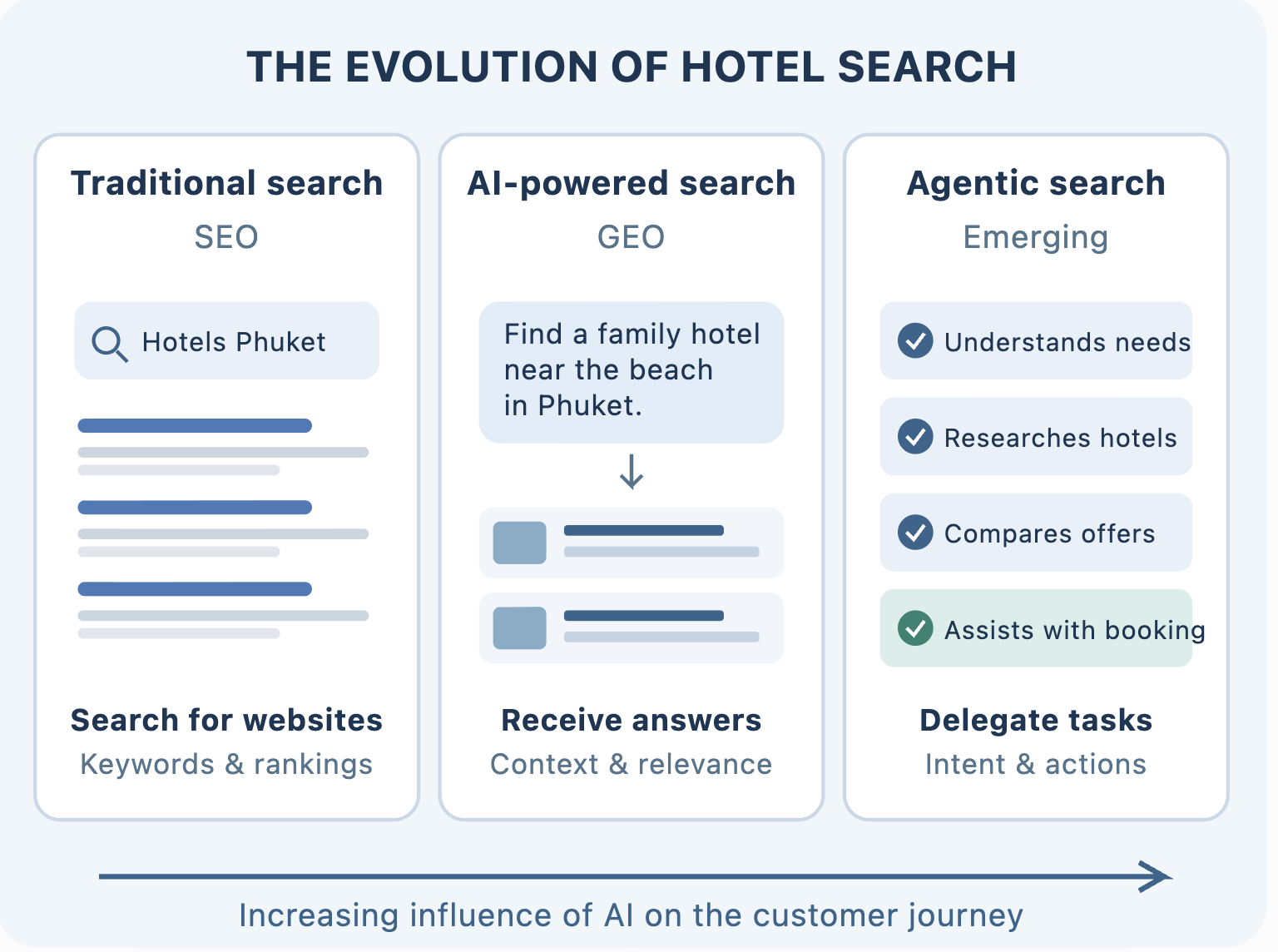
Traditional online search requires travellers to enter keywords, browse websites and compare results themselves.
For example, a traveller might search Google for:
“Best family hotels in Phuket.”
With AI-powered search, the same traveller might ask:
“Can you recommend a family-friendly hotel in Phuket, within walking distance of the beach, with a two-bedroom suite, a children’s swimming pool and local restaurants nearby?”
Instead of simply providing a list of websites, AI can interpret the traveller’s requirements, gather information from multiple sources and recommend a selection of suitable properties.
The next stage of this development is known as Agentic AI, where AI assistants can increasingly perform tasks on behalf of travellers, from researching accommodation and comparing offers to potentially assisting with reservations.
This represents a fundamental change in how hotels compete for visibility.
The Problem: Most Hotel Websites Were Not Built for AI
Many hotel websites have been designed to look attractive, present room types and facilities, and encourage visitors to make a reservation.
However, they may not provide the depth, structure and context that AI systems need to understand the property accurately.
A hotel may have beautiful photographs, excellent facilities and outstanding service, but its website may not clearly answer questions such as:
- Is the hotel suitable for families with young children?
- What restaurants and attractions are within walking distance?
- Which room types are suitable for longer stays?
- What makes the hotel different from other properties in the area?
- What experiences can guests enjoy during their stay?
- Is the hotel suitable for remote workers or wellness travellers?
When this information is missing, outdated or difficult to access, AI assistants may rely on third-party sources or recommend competing hotels with more comprehensive information.
 Beyond SEO: Introducing Generative Engine Optimization
Traditional Search Engine Optimization (SEO) remains important, but hotels should now also consider Generative Engine Optimization (GEO).
While SEO focuses on helping websites appear in traditional search results, GEO focuses on making hotel information easier for AI systems to discover, understand and reference when generating recommendations.
For hotels, this means developing a broader digital content strategy that includes:
- Relevant and informative blog articles.
- Frequently asked questions based on real guest enquiries.
- Detailed property, room and destination information.
- Content tailored to different traveller segments.
- Accurate and consistent information across online platforms.
- Structured website information and optimized metadata.
- Video content and destination storytelling.
This is not a replacement for SEO. It is an additional layer of digital marketing that reflects changing traveller behaviour.
Why This Matters for Direct Bookings
OTAs have significant resources to invest in AI technology, content development and customer acquisition.
Independent hotels, however, have an important advantage: they know their own property, their destination and their guests better than anyone else.
By making this knowledge available online through relevant and well-structured content, hotels can improve their opportunities to be discovered through AI-powered search.
The objective is not to replace OTAs, but to reduce the risk of becoming increasingly dependent on third-party platforms for online visibility.
Hotels should take greater ownership of how their property is represented, understood and discovered online.
Introducing HMS Agency AI
At HMS Thailand, we believe AI visibility should become part of every hotel’s commercial and distribution strategy.
This is why we are introducing HMS Agency AI, a dedicated service designed to help hotels improve their visibility in AI-powered search.
Our solution supports hotels through ongoing content development, including informative articles, guest FAQs, short videos, social media content, optimized metadata and regular website and AI visibility reporting.
Rather than treating AI optimization as a one-time project, we help hotels continuously develop their digital presence as travel search behaviour evolves.
How AI-Ready Is Your Hotel Today?
Before investing in a new strategy, it is important to understand your current position.
HMS Thailand invites hotels to conduct a FREE AI Visibility Audit, helping you understand how your hotel is represented in AI-powered search, how your website performs and where opportunities for improvement exist.
Visit our dedicated platform to request your complimentary audit:
Get Your Free AI Visibility Audit
The future of travel search is already taking shape.
When travellers ask AI to recommend their next hotel, will it recommend yours — or the one next door?
Source: Expedia Group, Booking.com and Agoda presentations at Phuket Tourism Outlook 2026–2027.